Laminated Dough Sheeting Line for Multi-Specification Production: Adjustable Width, Thickness, and Layer Control
Posted by Hengjiang intelligent
Filed in Card Games 146 views
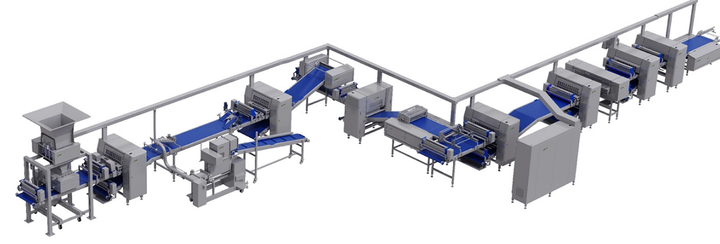
In modern bakery and food processing factories, production flexibility has become one of the most important competitive advantages. Manufacturers are no longer producing only one type of dough sheet for a single product. Today’s market requires rapid switching between croissants, puff pastry, Danish pastry, flatbread, pie crust, pizza base, biscuit dough, and frozen laminated products.
A high-performance Laminated Dough Sheeting Line is designed specifically for this challenge. By allowing precise adjustment of dough width, thickness, and layer count, the system supports multi-specification dough sheet production while maintaining stable product quality, continuous operation, and high production efficiency.
This article explains the technical structure, automation principles, processing advantages, and key engineering considerations of laminated dough sheeting lines in industrial food production.
What Is a Laminated Dough Sheeting Line?
A Laminated Dough Sheeting Line is an automated production system that continuously transforms bulk dough into uniform laminated dough sheets through rolling, reduction, folding, layering, and conveying processes.
The equipment is commonly used for:
- Puff pastry production
- Croissant dough processing
- Danish pastry manufacturing
- Frozen laminated dough
- Pie crust production
- Paratha and layered flatbread processing
- Biscuit and cracker dough preparation
Unlike traditional manual dough handling, automated sheeting lines provide highly accurate control over dough geometry and internal structure.
The key feature is the ability to produce different dough specifications using adjustable parameters without replacing the entire production system.
Why Adjustable Width, Thickness, and Layer Count Matter
Industrial bakeries often need to produce multiple products on the same line. A fixed sheeting system creates limitations in product diversity and increases downtime during changeovers.
An advanced laminated dough sheeting line solves this issue through flexible parameter adjustment.
Adjustable Dough Width
The dough width adjustment system enables operators to produce narrow or wide dough sheets according to downstream product requirements.
Typical applications include:
- Narrow strips for croissants
- Medium-width sheets for Danish pastries
- Wide sheets for pizza or pie dough
- Customized widths for frozen dough export products
Width adjustment is typically achieved through:
- Side guide positioning systems
- Servo-controlled spreaders
- Automatic centering conveyors
- Precision roller alignment
Maintaining uniform width is critical because inconsistent dough expansion can affect product appearance and baking consistency.
Adjustable Dough Thickness
Thickness control directly affects:
- Baking performance
- Internal texture
- Moisture retention
- Layer separation
- Final product weight
Modern laminated dough sheeting lines use servo-driven reduction rollers capable of micron-level adjustment precision.
The system may support thickness ranges from:
- Thick dough sheets for bread bases
- Medium sheets for pastry products
- Ultra-thin sheets for delicate laminated applications
Key engineering considerations include:
- Roller gap accuracy
- Roller surface hardness
- Dough stress control
- Reduction ratio optimization
- Temperature stability during sheeting
If thickness reduction is too aggressive, gluten structure may be damaged, causing shrinkage or poor layer definition.
Adjustable Layer Count
Layer count is one of the most important parameters in laminated dough production.
The number of layers determines:
- Flakiness
- Crispness
- Internal air pocket formation
- Final pastry volume
- Texture consistency
Layer control is achieved through repeated folding and sheeting operations.
For example:
- Simple folds
- Book folds
- Multi-stage laminating cycles
- Continuous folding conveyors
Different products require different layer structures.
Croissants may require moderate layering for elasticity, while puff pastry requires extremely high layer counts for expansion and flakiness.
Accurate layer control depends on:
- Butter distribution consistency
- Folding precision
- Dough temperature management
- Roller pressure control
- Conveyor synchronization
Core Components of a Laminated Dough Sheeting Line
A complete laminated dough sheeting line contains several integrated modules.
Dough Feeding Section
The feeding system transfers mixed dough into the sheeting section.
Important features include:
- Vacuum feeding systems
- Hopper buffering
- Dough stress reduction
- Anti-sticking surfaces
- Continuous feeding control
Stable feeding ensures consistent dough density before reduction.
Pre-Sheeting Rollers
Pre-sheeting gradually flattens the dough before final reduction.
The process prevents:
- Gluten tearing
- Uneven thickness
- Dough overheating
- Internal stress concentration
Multi-stage reduction is preferred over aggressive single-pass compression.
Laminating Unit
The laminating section introduces fat layers into the dough structure.
This unit usually includes:
- Butter extrusion systems
- Fat sheet positioning devices
- Folding conveyors
- Alignment correction systems
Temperature management is extremely important here because butter consistency directly affects layer integrity.
If butter becomes too soft:
- Layers may merge
- Oil leakage may occur
- Product expansion decreases
If butter becomes too hard:
- Cracking may appear
- Dough tearing increases
- Uneven lamination occurs
Gauge Rollers
Gauge rollers reduce dough thickness progressively to the final specification.
High-end systems use:
- Servo motor synchronization
- Digital thickness control
- Automatic pressure balancing
- Independent roller speed adjustment
Precision gauge rollers improve product repeatability across long production cycles.
Conveyor and Transfer Systems
The conveyor system must transport delicate dough sheets without deformation.
Important design factors include:
- Food-grade belt materials
- Anti-stick surfaces
- Tension control
- Belt tracking stability
- Hygienic structure design
Advanced systems use synchronized conveyors to minimize dough stretching during transfer.
Automation and Intelligent Control Systems
Modern laminated dough sheeting lines increasingly rely on intelligent automation.
PLC and HMI Integration
Programmable control systems allow operators to store and switch recipes quickly.
The HMI interface can control:
- Dough thickness
- Conveyor speed
- Roller gap
- Layer count
- Folding sequence
- Temperature settings
Recipe management significantly reduces setup time between products.
Servo Motion Control
Servo systems provide precise movement synchronization between rollers and conveyors.
Advantages include:
- Accurate dough positioning
- Stable tension control
- Reduced material waste
- Faster changeovers
- Improved consistency
Servo technology is especially important for high-speed laminated dough production.
Automatic Width Correction
Edge sensors continuously monitor dough alignment.
Automatic correction systems help prevent:
- Sheet deviation
- Uneven cutting
- Product size inconsistency
- Material waste
This function becomes critical during long continuous production shifts.
Temperature and Dough Stress Management
Temperature control is one of the most overlooked aspects of dough sheeting.
During continuous processing, friction generates heat that can damage dough structure.
Excessive temperature causes:
- Butter melting
- Gluten weakening
- Sticky dough surfaces
- Layer collapse
Industrial laminated dough sheeting lines often include:
- Cooling conveyors
- Refrigerated resting sections
- Climate-controlled production rooms
- Chilled rollers
Maintaining stable dough temperature improves lamination quality significantly.
Hygiene and Food Safety Design
Food manufacturers increasingly require hygienic equipment structures that comply with international food safety standards.
Important hygienic features include:
- Stainless steel construction
- Open-frame structures
- Tool-free cleaning access
- Washdown-compatible surfaces
- Minimal dead corners
- CIP-compatible components
Proper hygienic design reduces contamination risk and cleaning downtime.
Production Efficiency and Energy Optimization
Modern production facilities demand both high output and low operational cost.
Energy-efficient laminated dough sheeting lines may include:
- Variable frequency drives
- Intelligent motor load control
- Low-friction conveyor systems
- Energy-saving standby modes
- Optimized pneumatic systems
Production efficiency is also influenced by:
- Line speed stability
- Quick recipe switching
- Reduced product waste
- Automated cleaning systems
Common Technical Challenges in Dough Sheeting
Even advanced production lines can face technical challenges.
Dough Shrinkage
Causes:
- Excessive gluten stress
- Improper resting time
- Over-reduction
Solutions:
- Multi-stage sheeting
- Controlled dough relaxation
- Optimized roller reduction ratios
Uneven Thickness
Causes:
- Roller misalignment
- Conveyor instability
- Inconsistent dough feeding
Solutions:
- Automatic calibration
- Servo synchronization
- Real-time thickness monitoring
Layer Separation Failure
Causes:
- Incorrect butter consistency
- Excessive pressure
- High dough temperature
Solutions:
- Precise temperature control
- Improved fat handling
- Optimized folding sequence
Applications in Modern Food Manufacturing
Laminated dough sheeting lines are widely used in:
- Industrial bakery factories
- Frozen food production plants
- Central kitchens
- Pastry manufacturing facilities
- Ready-to-bake product lines
The equipment supports both high-volume standardized production and flexible customized manufacturing.
As consumer demand continues to diversify, multi-specification production capability becomes increasingly valuable.
Future Development Trends
Future laminated dough sheeting lines are moving toward:
- Fully automatic recipe switching
- AI-based process optimization
- Real-time dough analysis
- Predictive maintenance systems
- Remote monitoring
- Digital twin simulation
- Lower energy consumption
- Higher sanitation standards
Smart manufacturing technologies are transforming traditional bakery production into data-driven industrial processing systems.
Conclusion
A modern Laminated Dough Sheeting Line is far more than a simple dough rolling machine. It is a highly integrated processing system capable of accurately controlling dough width, thickness, and layer count for multi-specification production.
With advanced servo control, intelligent automation, precise temperature management, and hygienic engineering design, these systems help manufacturers achieve:
- Higher production flexibility
- Consistent product quality
- Reduced labor dependency
- Faster product switching
- Lower material waste
- Improved operational efficiency
For bakery and food manufacturers seeking scalable production and premium laminated products, investing in a flexible and technically advanced laminated dough sheeting line is becoming an essential strategy for long-term competitiveness.